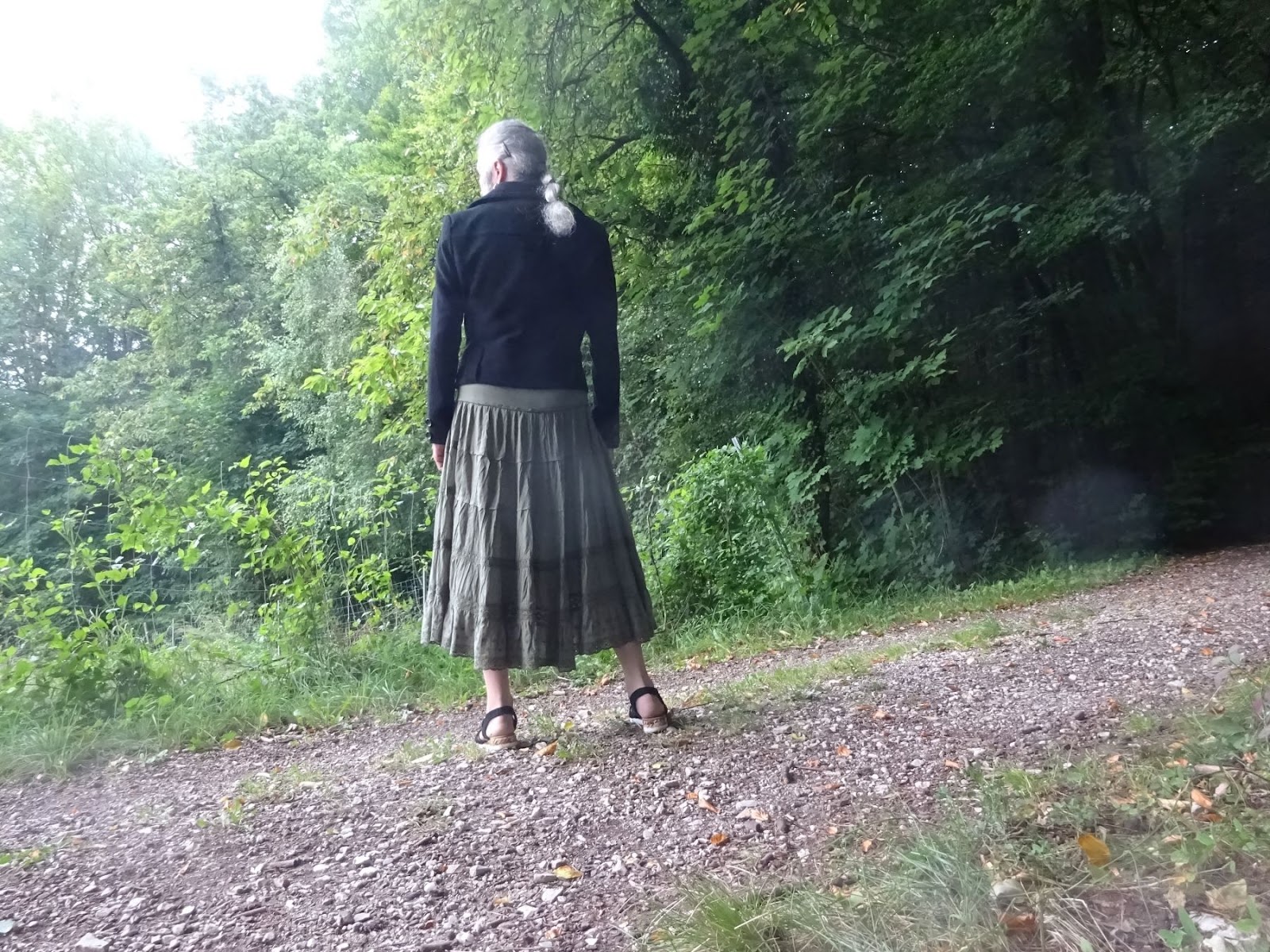
In Praise of Petticoats
Volume, Joy, and the Courage to Be Seen
There is a particular rustle that changes the air in a room. It’s a whisper of fabric, a soft percussion of tulle or organza brushing against itself, a gentle swish that announces movement before words arrive. Petticoats do that. They don’t shout; they sing. And in a world that often rewards the quiet flattening of silhouettes and the efficient erasing of softness, that song feels almost radical.
 |
| Another Pettioat Phase |
Let’s say it plainly: petticoats make people feel things. There are old fantasies attached to them - some male, some female, some simply human - about the mystery of volume, the glimpse of layers, the promise of swing. There is curiosity and nostalgia wrapped together, a memory of skirts that didn’t apologize for taking up space. It’s true that today, seeing someone in a proper petticoat is rare, mostly relegated to 1950s oldtimer shows, rockabilly festivals, vintage fairs, and lovingly curated nostalgia meetings. The petticoat has been placed behind glass, labeled costume, when it was once everyday magic.
But why?
Some say it’s impractical. Some say it’s outdated. Some say it clashes with modern ideas of feminism. And yet, none of those explanations fully hold up when you actually put one on.
💖 Put on a petticoat, and you feel feminine from the first second on. 💖
💖 Put on a petticoat, and you have swing in every one of your movements. 💖
💖 Put on a petticoat, and you instinctively move with grace. 💖
💖 Put on a petticoat, and you will be the appearance when you enter a room. 💖
Why should all this be weak?
The Forgotten Language of Volume
Clothing has always spoken. Before we ever said "this is who I am," we showed it. Wide sleeves meant wealth. Tight corsets meant discipline. Flat shoes meant work. And full skirts - buoyant, unapologetic skirts - meant celebration.
A petticoat is not just an undergarment. It is architecture. It shapes space around the body. It creates distance between skin and world, a little dome of air and movement that turns walking into choreography. When you wear one, you don’t just occupy space - you compose it.
Modern fashion often celebrates minimalism: clean lines, neutral palettes, silhouettes that skim rather than proclaim. There is beauty in that, absolutely. But somewhere along the way, volume was mistaken for excess, and excess for frivolity. The idea crept in that seriousness must be narrow, that confidence must be sharp-edged, that strength must look streamlined.
Petticoats refuse that idea. They say: I can be strong and expansive. I can be capable and decorative. I can know exactly who I am while wearing something that sways when I move.
Femininity Is Not an Apology
There’s a persistent misunderstanding that femininity - especially visible, joyful femininity - is a performance for others. That it exists to please, to attract, to decorate someone else’s world. This misunderstanding is at the root of the discomfort some people feel around overtly feminine clothing.
But here’s the quiet truth: a petticoat is intensely self-referential.
You feel it before anyone else sees it. You feel the light pressure at your waist. You feel the gentle resistance when you sit down. You feel the way it nudges your posture into a soft uprightness, how it changes your gait without forcing it. It reminds you of your body in motion. It invites awareness.
This is not submission. This is presence.
Why should a feminine appearance not caress a strong and self-confident person? Why should softness be interpreted as uncertainty? Why should grace be mistaken for fragility?
Strength does not require ugliness. Confidence does not require concealment. Feminism - at its best - was never meant to replace one uniform with another. It was meant to open doors, not close wardrobes.
Choosing a petticoat is not a retreat into the past. It is a choice, made consciously, to embrace a form of expression that refuses to be small.
The Swing That Changes Everything
Anyone who has worn a real petticoat knows this: movement becomes joy.
You turn, and the world follows half a second later. You walk, and your steps acquire rhythm. Even standing still feels different, because the fabric remembers motion even when you pause.
There is science behind this, of course. The added mass and distribution of fabric amplify movement, making small gestures visible. But there is also something more elusive happening - a feedback loop between body and mind.
When your clothes respond to you, you respond in kind.
You lift your chin a little. Your shoulders relax. Your hands find quieter, more deliberate paths through the air. Not because you’re pretending to be someone else, but because the clothing invites you to inhabit yourself fully.
This is why petticoats feel theatrical even in mundane settings. Not because they demand attention, but because they make you attentive. They turn errands into entrances, corridors into runways, mirrors into moments of recognition.
About Those Fantasies
Yes, there are fantasies attached to petticoats. Always have been. The glimpse of layers, the suggestion of what’s hidden, the contrast between public volume and private closeness - these elements have fueled imaginations for generations.
But fantasies do not own the garment.
The mistake is thinking that because something is desired, it must be weak. Or because it attracts attention, it must be shallow. A confident person does not fear being seen. A self-assured person does not surrender agency by wearing something that others might admire.
On the contrary: choosing to wear a petticoat in a world that finds it unusual is an assertion of autonomy. It says, "I am not dressing to disappear. I am dressing to exist, fully."
And let’s be honest - there is something profoundly powerful about walking into a room knowing you will be noticed, not despite your confidence, but because of it. The rustle announces you before you speak. The silhouette claims space without asking permission.
That is not weakness. That is presence with velvet edges.
Practicality, Reimagined
Is a petticoat practical? That depends on what we mean by practical.
If practicality means "optimized for speed and invisibility," then no, perhaps not. But if practicality includes joy, self-expression, and the quiet boost of feeling aligned with yourself, then the answer changes.
We accept impracticality all the time. We wear jewelry that serves no purpose but beauty. We choose colors that lift our mood. We decorate homes beyond bare necessity. Why should clothing that creates delight be held to a harsher standard?
Moreover, petticoats are not as impractical as legend suggests. Modern materials are lighter. Designs are smarter. And daily life has room for small acts of ceremony, even on ordinary days.
Sometimes, the most practical thing you can do is remind yourself who you are.
"I Know Who I Am"
Put on a petticoat, and you will emanate: I know who I am and what suits me.
This is perhaps the most important part. Not the nostalgia. Not the swing. Not the attention. The clarity.
In a culture that constantly asks us to justify our choices, wearing something so deliberately expressive is a quiet refusal to explain. It doesn’t argue. It doesn’t debate. It simply exists, buoyant and certain.
You don’t need permission to enjoy femininity. You don’t need to dilute it to make it acceptable. You don’t need to apologize for taking up visual space.
Petticoats remind us that confidence can be soft, that strength can be playful, and that self-knowledge can rustle when you walk.
Maybe they are rare now. Maybe they mostly appear at vintage shows and nostalgia meetings. But rarity has its own power. When something appears against expectation, it resets the room. It invites a second look. It opens a small crack where joy can slip in.
And perhaps that’s the real reason to wear one - not to relive the past, but to gently insist on a future where femininity, confidence, and delight are not seen as opposites, but as allies.
Do I know who I am?
The honest answer is: yes - and also no, and sometimes, and differently on different days.
I have my phases, like most probably any other woman. There are weeks, sometimes months, when no petticoat leaves the wardrobe. Life happens. Routines tighten. Comfort becomes quiet, efficient, almost invisible. And during those times, I am not less myself - I am just another version of myself. Still whole. Still real.
And then ... something shifts.
Then there are weeks when you see me wearing a petticoat nearly every day.
Not because I must. Not because I am trying to prove something. But because suddenly, that part of me wants air again. Volume again. Swing again. It’s like rediscovering a familiar melody and wondering how I ever stopped humming it.
Those are the weeks when I feel especially aligned - inside and out.
I wear a petticoat to my own joy first. That matters. The private delight of feeling the fabric move with me, of catching my reflection and smiling without thinking, of walking a little slower just because it feels good. It’s a reminder that joy does not need a reason beyond itself.
But joy rarely stays private.
I see it in the eyes of my beloved ones, who simply like to see their special girl like that. They don’t see a costume. They don’t see nostalgia. They see me - confident, radiant, unmistakably present. They feel the lift in my mood, the lightness in my steps, the way my laughter seems to arrive half a second before I do (and of ourse my skirt half a second later 😄).
And then there are the others.
Strangers. Acquaintances. People who admire my self-confidence and sometimes admit, almost shyly:
"I wouldn’t dare."
That sentence always lingers.
Why not?
What is this invisible line that says this much expression is allowed, but not more? Who decided that enjoying visibility requires courage instead of being a simple right? Why does wearing something joyful feel like an act of bravery rather than an act of honesty?
When I wear a petticoat, I am not claiming certainty about everything in my life. I am not pretending I have it all figured out. What I am saying is this: today, I choose myself. Today, I choose the version of me that enjoys swing and softness and presence. Today, I choose to be seen.
And that choice can change. It does change. That’s not weakness - that’s being alive.
Knowing who you are does not mean freezing yourself into one shape forever. It means allowing yourself to move between shapes without shame. Sometimes streamlined. Sometimes expansive. Sometimes quiet. Sometimes rustling.
So yes, there are phases without a petti. And then there are phases filled with them. Both are true. Both are me.
But I do have another petticoat phase now - one that began at the start of the year - and I am savoring it with a kind of calm happiness that feels earned. I enjoy every look that I feel on my skin before I even notice it in a mirror. I enjoy every smile that appears, sometimes surprised, sometimes delighted, sometimes simply warm. I enjoy every compliment, not because I need it, but because it confirms a shared moment of beauty, a brief recognition between people who may never speak again.
What I enjoy most, though, is the ease of it. The way this choice settles into my day without effort. The way it feels natural again to move with swing, to let my presence be visible, to allow joy to be readable on my silhouette. It’s not about standing out for the sake of it. It’s about standing in myself.
And when someone says, "I wouldn’t dare," I no longer hear hesitation - I hear a door half-open.
You don’t dare? Why not?
💖 Simply put on a petticoat. 💖
💖 Feel the swing. 💖
💖 Hear the whisper. 💖
💖💖💖 Walk into the room as yourself - fully, joyfully, unmistakably there. 💖💖💖


i have never worn one, but reading this lovely post has definitely got me thinking. Thank you.
ReplyDeletep
x
Join the petticoat gang, please, you'll love it
Delete💖 Simply put on a petticoat. 💖
💖 Feel the swing. 💖
💖 Hear the whisper. 💖
💖💖💖 Walk into the room as yourself - fully, joyfully, unmistakably there. 💖💖💖
Thank you for sharing Kirsten. I've been infatuated with petticoats ever since I was a child. Love the petticoats and pettipants that were part of those lovely square dance outfits. Do you remember the website "Petticoat Pond?" The creator of the site sadly passed away in 2021, but you can still access the site at www.pettipond.org. It is worth a visit!
Deletexox
sissy terrie
Ich nehme mal an, liebe Kirsten, daß Du, da im Profil Deutschland steht und Du mir - vielen Dank dafür- einen netten Kommentar in deutsch in meinem Blog hinterlassen hast, daß Du deutsch sprichst. Es ginge auch auf englisch, aber muß nicht sein. Ja, daß man sich mit Petticoats weiblich fühlt und Aufmerksamkeit erweckt ist mir klar. Ich bin allerdings kein Fan davon. Kann ich auch nicht genau sagen warum - ist einfach so. Aber ich verstehe, daß man dafür eine Leidenschaft entwickeln kann. Und daß wir uns enfemme wohlfühlen ist ja das Wichtigste.
ReplyDeleteLiebe Grüße und eine gute Zeit
Violetta